ECHO on BabyAI
Introduction
ECHO has shown promise in coding-style tasks, where predicting environment feedback or terminal output provides a dense auxiliary signal alongside reinforcement learning. We wanted to test whether the same idea would transfer to a more embodied setting: an agent acting in a small world, receiving a new observation after every action, and learning from both reward and the environment.
We studied this question on BabyAI using prime-rl’s built-in ECHO algorithm in a deliberately constrained setting: each rollout had at most 20 interaction turns, and the model’s explicit thinking mode was disabled. This emphasized short, action-oriented decision making and made interaction efficiency part of the experiment. This setting is relevant to embodied and robotics-like agents, where response latency and action efficiency can matter alongside planning quality. We compared RL with three ECHO variants, using ECHO weights of 0.05, 0.5, and 1.0. For this main comparison, we ran three independent 100-step training runs per setting. In separate single-run experiments, we switched between RL and ECHO midway through 100-step training and at different points in extended 200-step schedules. We also ran single-run ablations that alternated RL with SFT-only phases trained on observation tokens to isolate the contribution of observation prediction.
In the main comparison, all three ECHO variants produced higher final mean held-out rewards than RL, and stronger ECHO weights reduced both average trajectory length and the number of candidate rollouts required to fill a training batch under the 20-turn constraint. The switching experiments showed that RL and ECHO could hand off without a persistent collapse and suggested that a short ECHO warmup followed by RL could be useful. SFT-only phases did not sustain task performance, indicating that observation prediction did not replace the RL signal in this setting.
ECHO objective
RL updates the assistant action tokens using reward-derived advantages. ECHO retains that policy objective and adds a next-token prediction loss over environment-observation tokens that arrive after assistant actions. The model sees those observations as context during rollout; the auxiliary loss teaches it to predict them during training. Standard ECHO therefore combines both components in the same update rather than training only on environment outputs.
λ is the ECHO weight. GRPO trains assistant action tokens, while SFT trains observation tokens.
Conceptually, a trajectory is trained in two complementary ways:
Assistant: move forward          <- ECHO RL component (policy objective)
Environment: You see a red ball <- ECHO SFT component (observation prediction)
Assistant: pickup red ball 0     <- ECHO RL component (policy objective)
Environment: You picked it up    <- ECHO SFT component (observation prediction)
Task and setup
We use BabyAI from AgentBoard, a collection of partially observable grid-world instruction-following tasks. The agent does not receive the full map. At each turn, it receives a text rendering of its egocentric field of view, describing visible objects relative to its current position, nearby walls, and what it is carrying. Objects include colored balls, boxes, keys, and doors; doors may be closed or locked, so information and objects outside the current view must be found through exploration.
The benchmark covers 28 BabyAI subtask families. A subtask family is an environment template with a shared goal structure, generation rules, and difficulty setting; individual tasks within a family are different generated layouts and object placements. For example, every GoToDoor task asks the agent to reach a specified door, while each instance can use a different map, door color, and starting state. The families in our dataset are:
| Primary goal | BabyAI subtask families |
|---|---|
| Navigate and find | GoToRedBallGrey, GoToRedBall, GoToRedBallNoDists, GoToObjS6, GoToLocalS8N7, GoToObjMazeS7, GoToImpUnlock, GoToSeqS5R2, GoToRedBlueBall, GoToDoor, GoToObjDoor, FindObjS7 |
| Open doors | Open, OpenRedDoor, OpenDoorLoc, OpenRedBlueDoorsDebug, OpenDoorsOrderN4Debug |
| Pick up and manipulate | Pickup, UnblockPickup, PickupLoc, PickupDistDebug, PickupAbove |
| Unlock and multi-stage | KeyCorridorS6R3, Unlock, UnlockLocalDist, UnlockPickupDist, UnlockToUnlock, BlockedUnlockPickup |
These families include objectives such as navigating to a specified object or door, picking up an object, opening or unlocking doors, completing ordered sequences, and moving obstructions to reach a target. The policy emits short text actions such as turn left, move forward, pickup red ball 0, or toggle blue door 1; after each action, the environment returns a new partial text observation. Each family contributes four generated tasks: three are used for training and one is held out for evaluation.
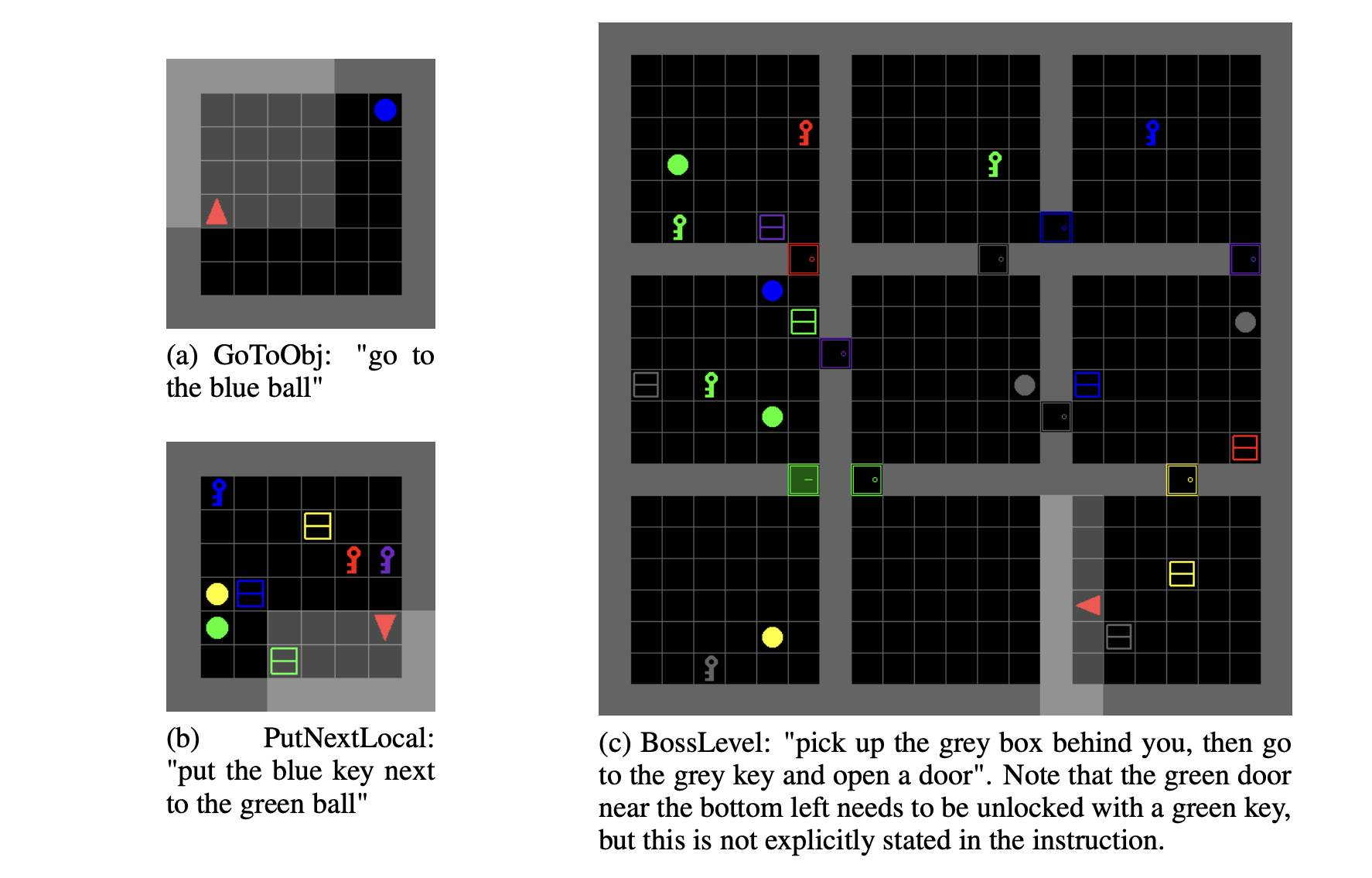
Examples of three BabyAI levels. Source: Figure 1 from Chevalier-Boisvert et al., “BabyAI: A Platform to Study the Sample Efficiency of Grounded Language Learning”, ICLR 2019.
We use 84 training tasks and 28 held-out tasks, preserving the same 3:1 split within each BabyAI subtask family. The main configuration is:
| Setting | Value |
|---|---|
| Model | Qwen3.5-9B |
| Training length | 100 policy updates |
| Trainable batch | 128 rollouts |
| Rollouts per task group | 8 |
| Maximum interaction length | 20 turns |
| Sampling temperature | 0.7 |
| Thinking | Disabled |
| Held-out evaluation | 28 tasks × 3 rollout replicates per checkpoint |
With explicit thinking disabled, each decision was intended to map the partial observation and accumulated trajectory to a short action rather than an exposed chain-of-thought deliberation. Combined with the 20-turn cap, this made the experiment a test of action-oriented navigation under tight interaction and inference budgets.
The turn cap acted as a coarse length penalty because a policy that required additional actions could not continue collecting progress. The reward comparison therefore reflected both task learning and the ability to make progress within a fixed interaction budget. This may favor policies that solve tasks in fewer turns, and RL could match or exceed ECHO if given a larger budget.
Despite this limitation, the constrained setting remains practically meaningful. Inference costs and fixed agent budgets make length efficiency important. “True Agents Model the World” found that ECHO runs also tended to use fewer turns under a larger turn budget, suggesting that this behavior is not limited to tightly capped runs. However, our BabyAI results do not establish whether the reward advantage would persist if the 20-turn cap were relaxed.
ECHO vs. RL
We first compared RL with ECHO weights 0.05, 0.5, and 1.0 to test whether observation prediction changed reward, training consistency, turn usage, and rollout efficiency, and whether those effects depended on its weight. We ran each of the four objectives three times independently. At every evaluation checkpoint, each run was evaluated on all 28 held-out tasks with three rollout replicates per task. The bold curves below average the three independent training runs, and the bands show plus or minus one sample standard deviation across those runs.
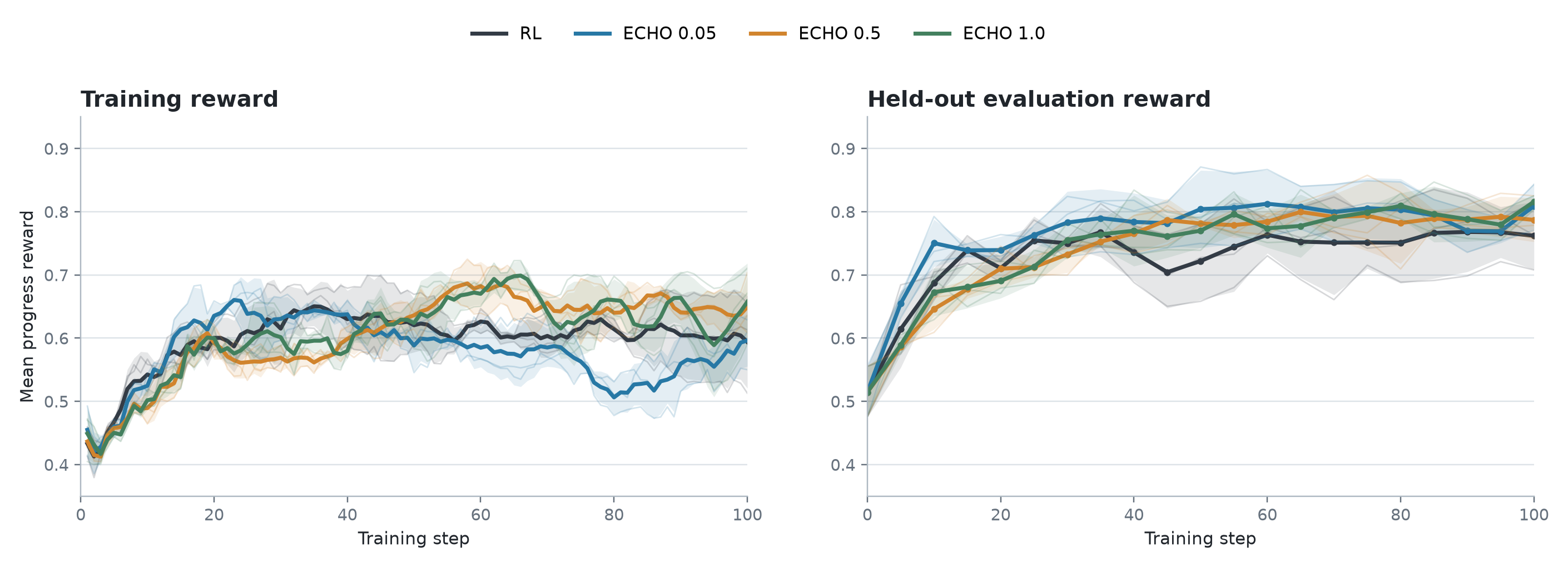
Training reward uses a five-step moving mean. Bold lines are means across three independent training runs; faint lines show the individual runs; bands are plus or minus one sample standard deviation across runs.
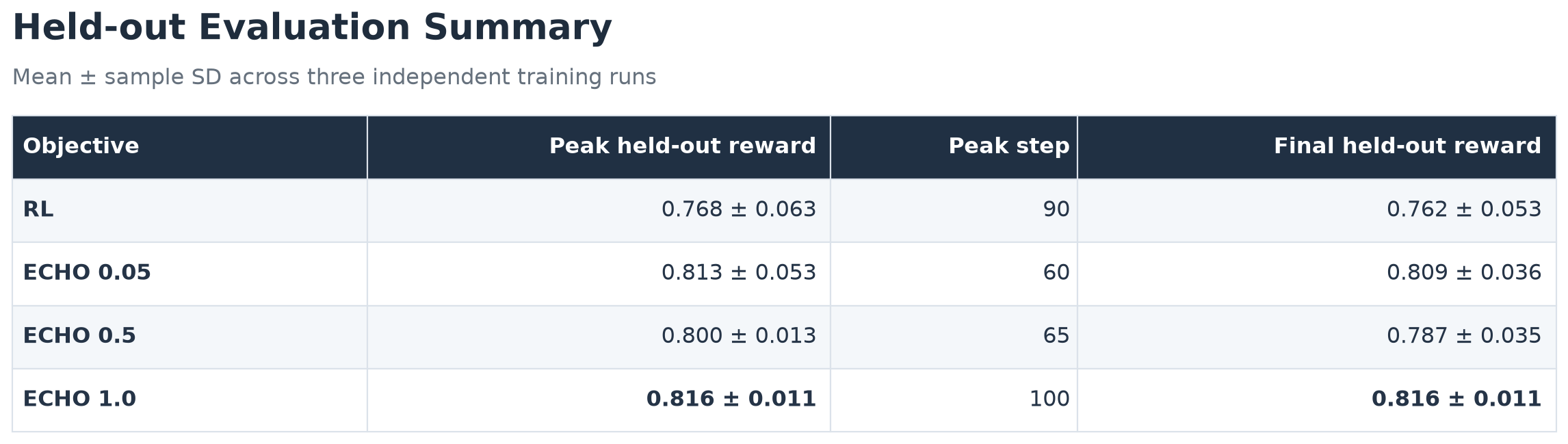
Across three independent training runs, all three ECHO variants finished above RL in mean held-out reward. ECHO 0.05 reached its best mean earliest, at step 60. ECHO 1.0 improved more gradually, reached the strongest final mean, and had the smallest across-run variation at step 100.
RL also had the largest run-to-run variation at the final checkpoint: its SD was 0.053, compared with 0.036 for ECHO 0.05, 0.035 for ECHO 0.5, and 0.011 for ECHO 1.0. Every tested ECHO weight achieved a higher peak and final mean reward than RL while also producing a more consistent final result across runs.
These findings are promising but scoped. We tested one model size in one embodied AI environment using 84 training tasks and 28 held-out tasks, with three independent training runs per objective. They provide evidence that ECHO handles this length-constrained embodied setting well and motivate future work across turn limits, environments, model families, and dataset sizes.
Output behavior and token usage
Every policy was allowed up to 1,024 tokens per action even though BabyAI requires only one short action phrase. At higher ECHO weights, the trained policy sometimes continued the trajectory format inside its own response, generating imagined observations and additional actions instead of stopping after its first action.
An abridged held-out example from ECHO 1.0 is:
go to blue locked door 1                         <- executed by the environment
Observation: There is a blue locked door ...    <- imagined by the model
Action: toggle and go through blue locked door 1
Observation: There is a yellow closed door ...
Action:
The BabyAI harness parses and executes only the first line. The first action can therefore still earn reward even when the remainder of the completion is malformed. The complete assistant response nevertheless remains in the saved trajectory and subsequent model context, increasing both generated tokens and the prompt length of later turns.
Importantly, this behavior did not persist. In the follow-up 200-step ECHO 1.0 experiment shown below, output-limit completions largely disappeared by step 85 and were absent after step 150, showing that continued training removed this measured form of output drift in that run.
For the replicated 100-step runs, we next measured all tokens processed during held-out evaluation, not only the environment observations that received ECHO supervision. The plot separates environment-observation tokens from assistant-output tokens and reports total processed tokens, including prompt, trajectory history, and chat-template overhead.
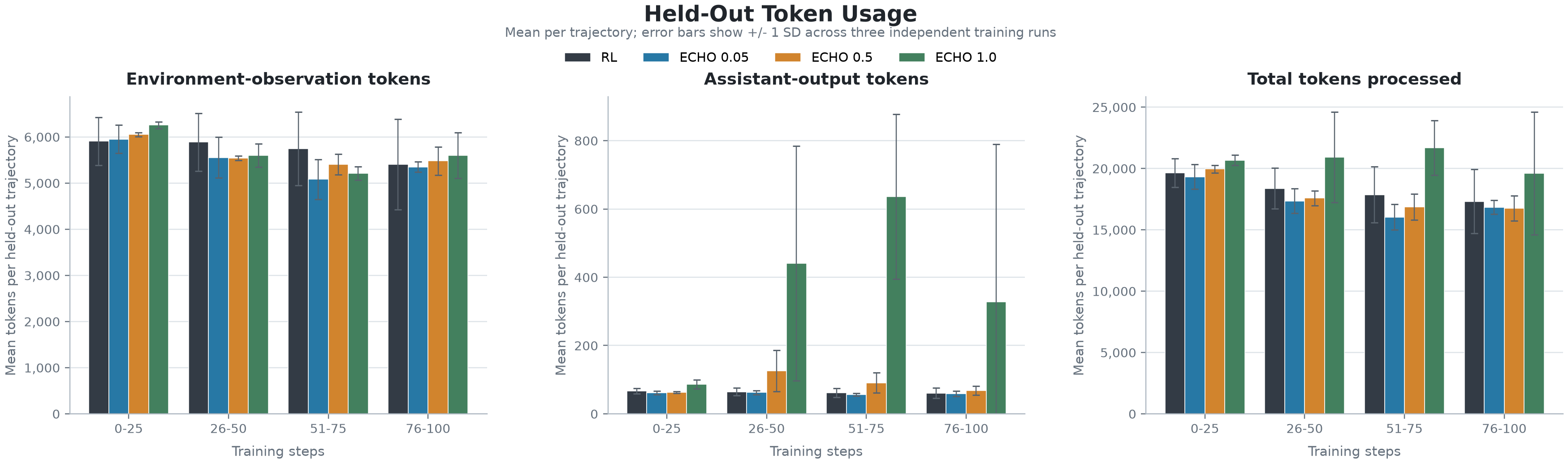
Bars show mean tokens per held-out trajectory, and error bars show plus or minus one sample standard deviation across three independent training runs. Each step window pools evaluations from every five-step checkpoint over 28 held-out tasks with three rollout replicates. Environment observations are counted each time they are processed, so earlier observations can be counted again on later turns. Total tokens also include the system message, initial prompt, prior-action history, and chat-template overhead.
Environment-observation processing remains broadly similar across objectives. The large assistant-output counts at higher ECHO weights are driven by a minority of transcript-like completions rather than uniformly longer action strings. They should not be interpreted as evidence that the model learned an accurate simulator.
To show how concentrated this behavior was, we also measured the percentage of held-out trajectories containing at least one assistant completion that exhausted the 1,024-token output limit.
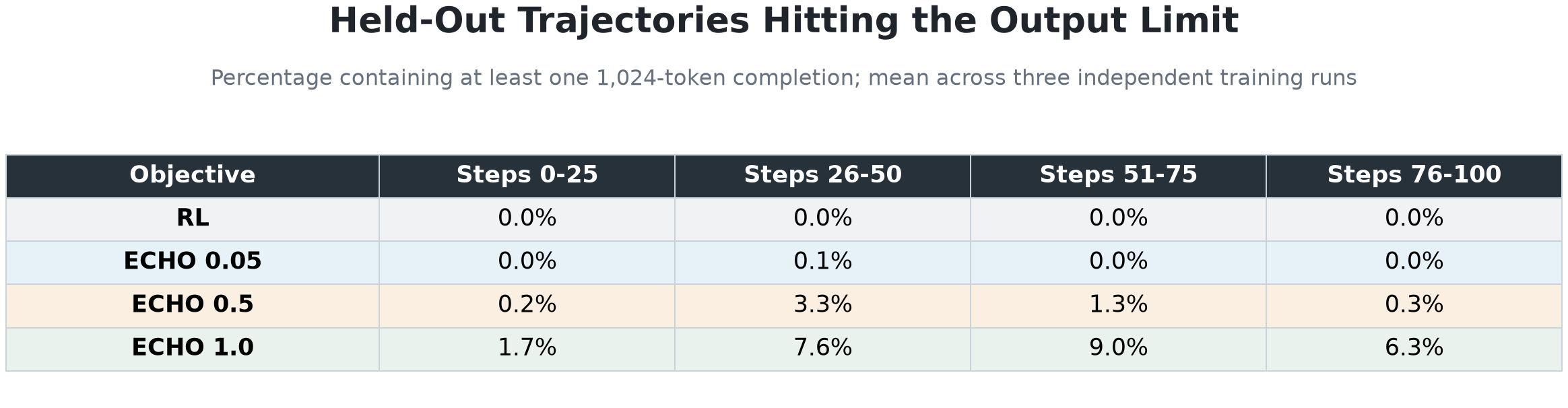
Percentage of held-out trajectories containing at least one 1,024-token assistant completion. Each five-step checkpoint evaluates 28 held-out tasks with three rollout replicates; values are grouped into the training-step ranges shown in the column headers and then averaged across three independent training runs.
This behavior could be constrained at inference by stopping generation at the first newline, enforcing a one-action output grammar, or using a substantially smaller completion limit. The present experiments preserve the same 1,024-token limit for RL and ECHO, which exposes that ECHO can induce trajectory continuation or role confusion without necessarily destroying the useful policy encoded in the first action.
Switching objectives after 50 steps
After comparing fixed objectives, we asked whether RL and ECHO could hand off to one another during training. Each schedule ran for 100 updates and switched at the midpoint. We write RL (50) → ECHO (50) for 50 RL updates followed by 50 ECHO updates, and ECHO (50) → RL (50) for the reverse. Parenthesized numbers denote update counts, while the ECHO weight is stated separately. Standard ECHO still includes the RL policy objective; switching to ECHO adds the observation-prediction loss, while switching back to RL removes it.
We tested both directions at ECHO weights 0.05, 0.5, and 1.0. Each schedule has one training run. Every evaluation checkpoint covers all 28 held-out tasks with three rollout replicates, so the evaluation bands show variation across rollout replicates rather than across independent training runs.
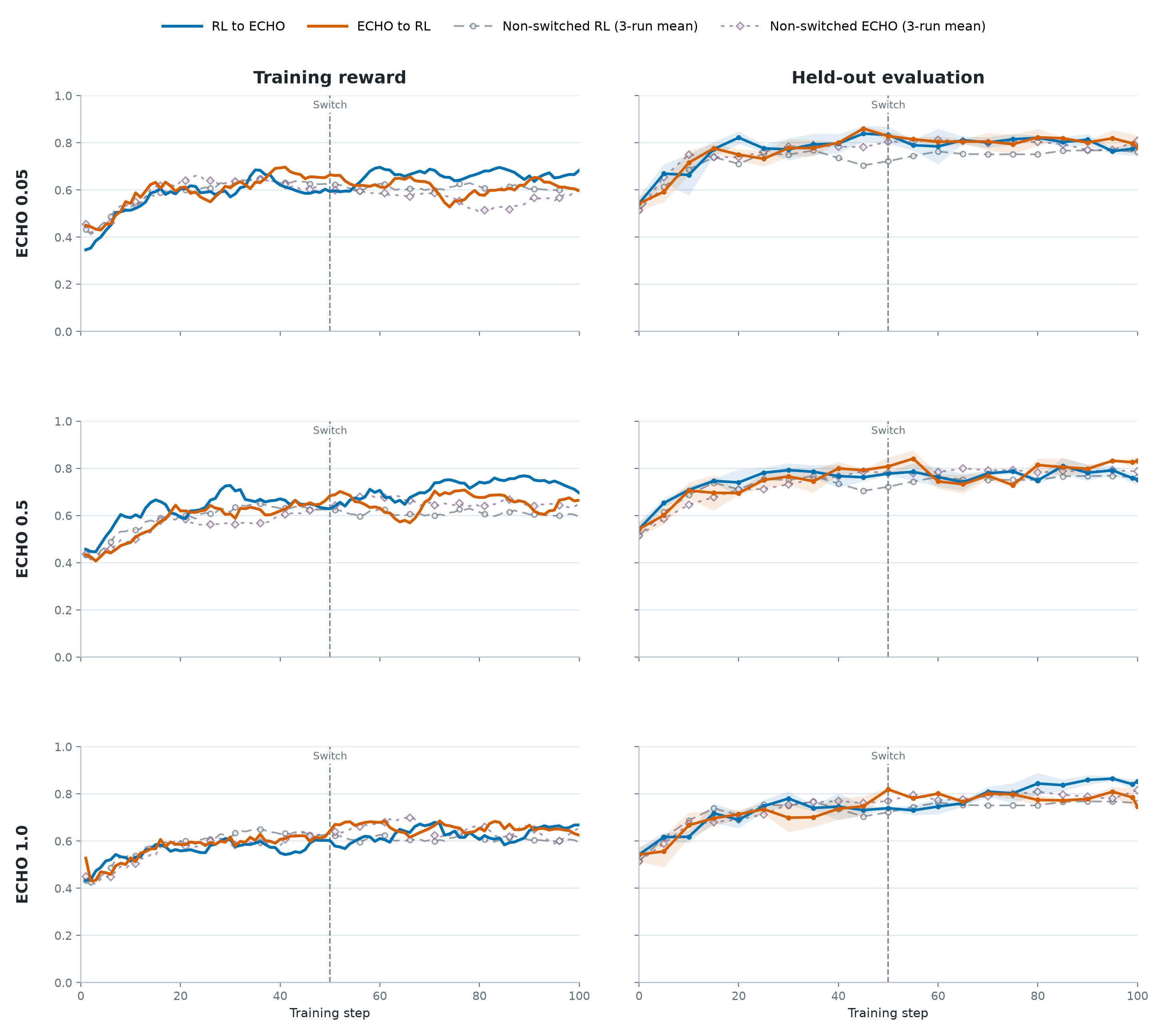
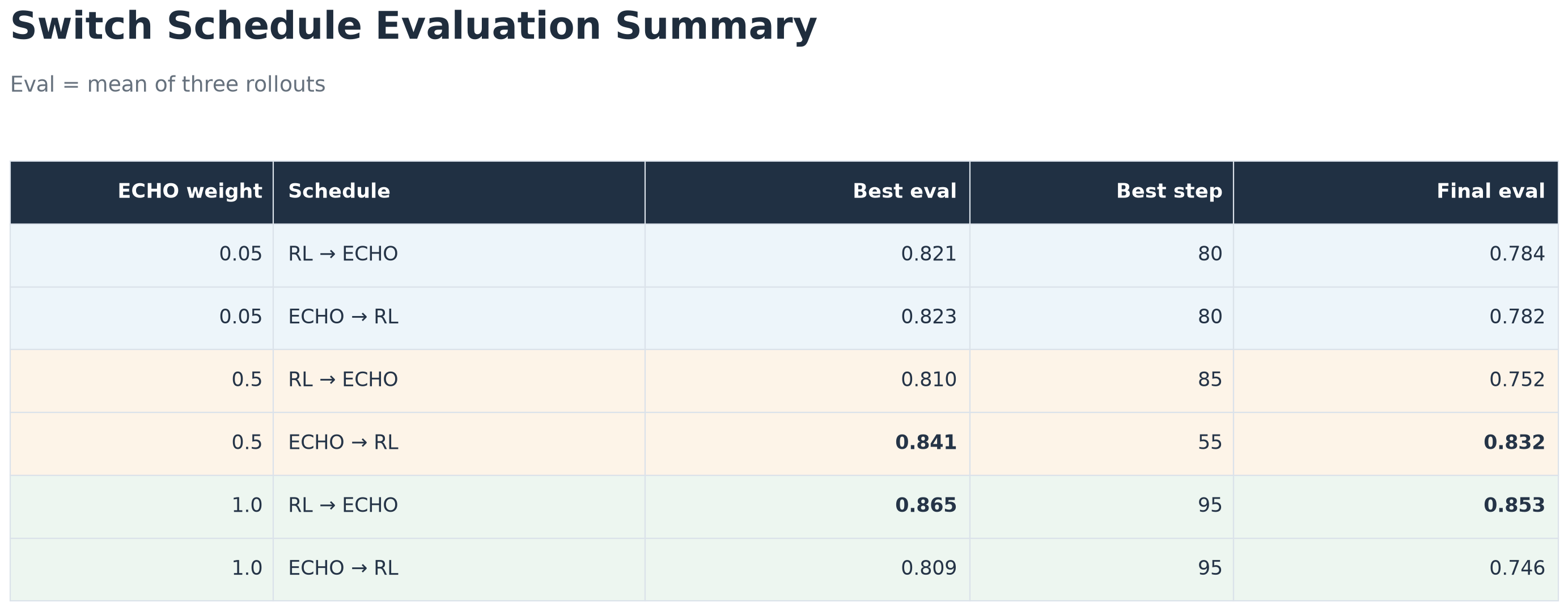
The ordering effect depended on the ECHO weight. At 0.05, the two directions were effectively tied: their best post-switch evaluations were 0.821 and 0.823, and they finished at 0.784 and 0.782. At 0.5, ECHO (50) → RL (50) was stronger, finishing at 0.832 compared with 0.752 for RL (50) → ECHO (50). At 1.0, the result reversed: RL (50) → ECHO (50) reached 0.865 at step 95 and finished at 0.853, while ECHO (50) → RL (50) peaked at 0.809 after the switch and finished at 0.746.
These runs show that switching between RL and ECHO is feasible, but they do not establish a generally better ordering or switch point. Each schedule has only one training run, and the best direction changed with the ECHO weight. The result may also vary across benchmarks.
Extending the schedules to 200 steps
The 100-step experiments showed that the objectives could hand off without a universal collapse. We next used ECHO 1.0, the strongest final configuration in the primary comparison, to test whether the behavior persisted over 200 updates. Each schedule below has one training run, and every evaluation checkpoint again covers the 28 held-out tasks with three rollout replicates per task.
200-step baselines
We first trained RL and ECHO 1.0 independently for 200 updates without changing objectives. These uninterrupted runs provide the reference comparison for the switching schedules below and test whether the difference observed at 100 steps persists, disappears, or emerges differently with additional optimization.
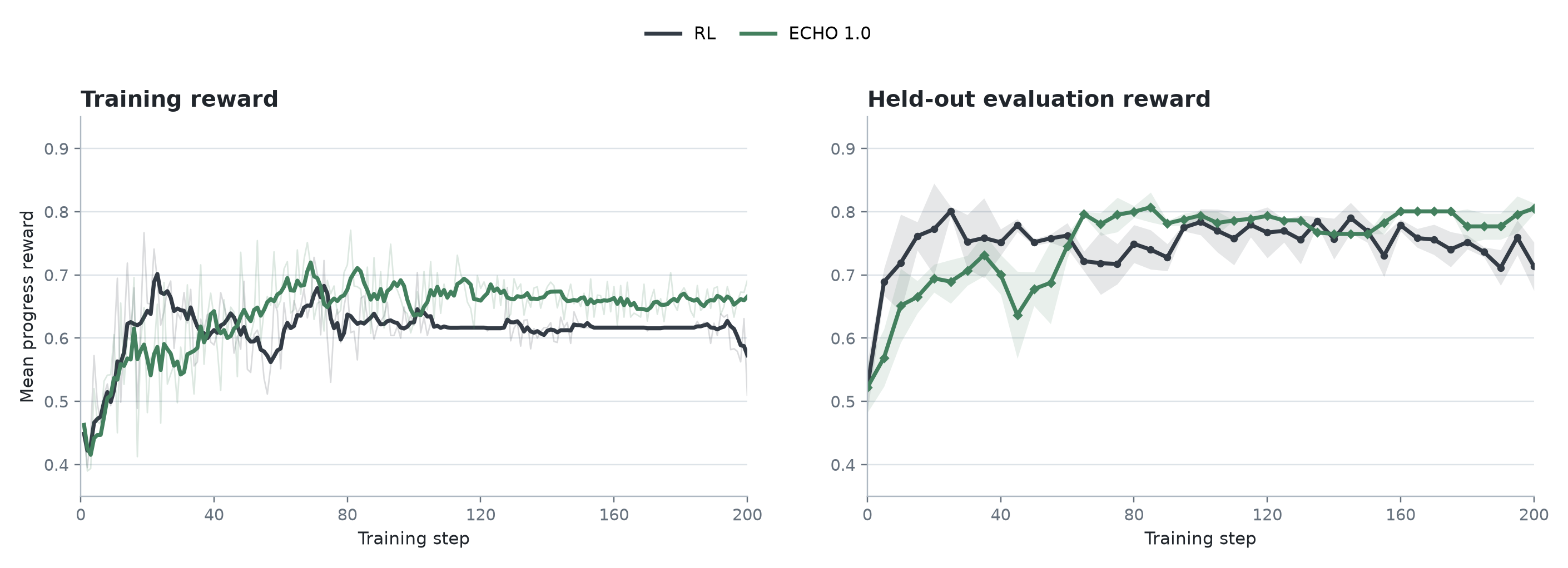
The 200-step RL and ECHO 1.0 reference runs reached similar peak held-out rewards, but on different timelines. RL reached 0.801 at step 25, then lost much of that gain and finished at 0.713. ECHO 1.0 peaked later, reaching 0.807 at step 85, and held that performance through the end of training with a final reward of 0.805. These runs serve as reference curves for the switching experiments below.
The 100-step experiments showed that higher ECHO weights could induce transcript-like continuations in the model’s output. In the separate 200-step ECHO 1.0 run, this behavior appeared temporary: the fraction of held-out trajectories that exhausted the output-token limit peaked at 50% at step 45, largely disappeared by step 85, and remained at zero after step 150. During steps 176–200, ECHO averaged 9.6 turns and 16,155 processed tokens per trajectory, compared with 11.7 turns and 19,948 tokens for RL. This single-run evidence suggests that the policy recovered from the output drift rather than remaining trapped in it.
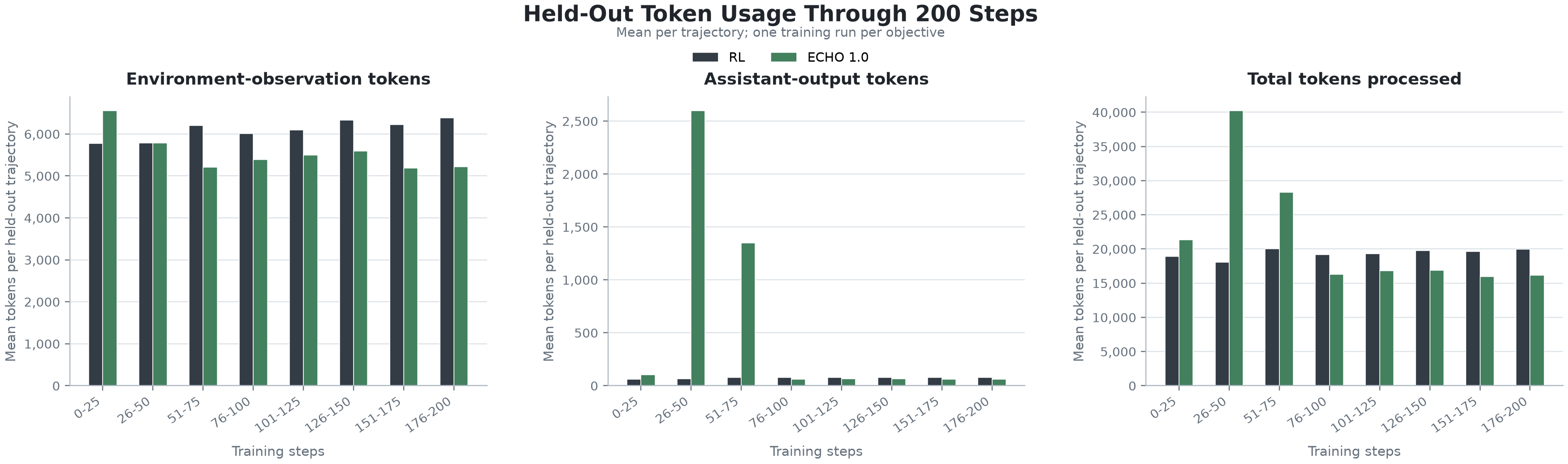
Bars show mean tokens per held-out trajectory from one training run per objective. Each step window pools five-step checkpoints, and each checkpoint evaluates 28 held-out tasks with three rollout replicates. Environment observations are counted again whenever they are processed on later turns. Total tokens also include the system message, initial prompt, prior-action history, and chat-template overhead.
Switched after 100 steps
We then repeated the midpoint switch over a longer horizon. RL (100) → ECHO (100) means 100 RL updates followed by 100 ECHO 1.0 updates; ECHO (100) → RL (100) reverses that order. This keeps the two phases equal in length while moving the switch from step 50 to step 100.
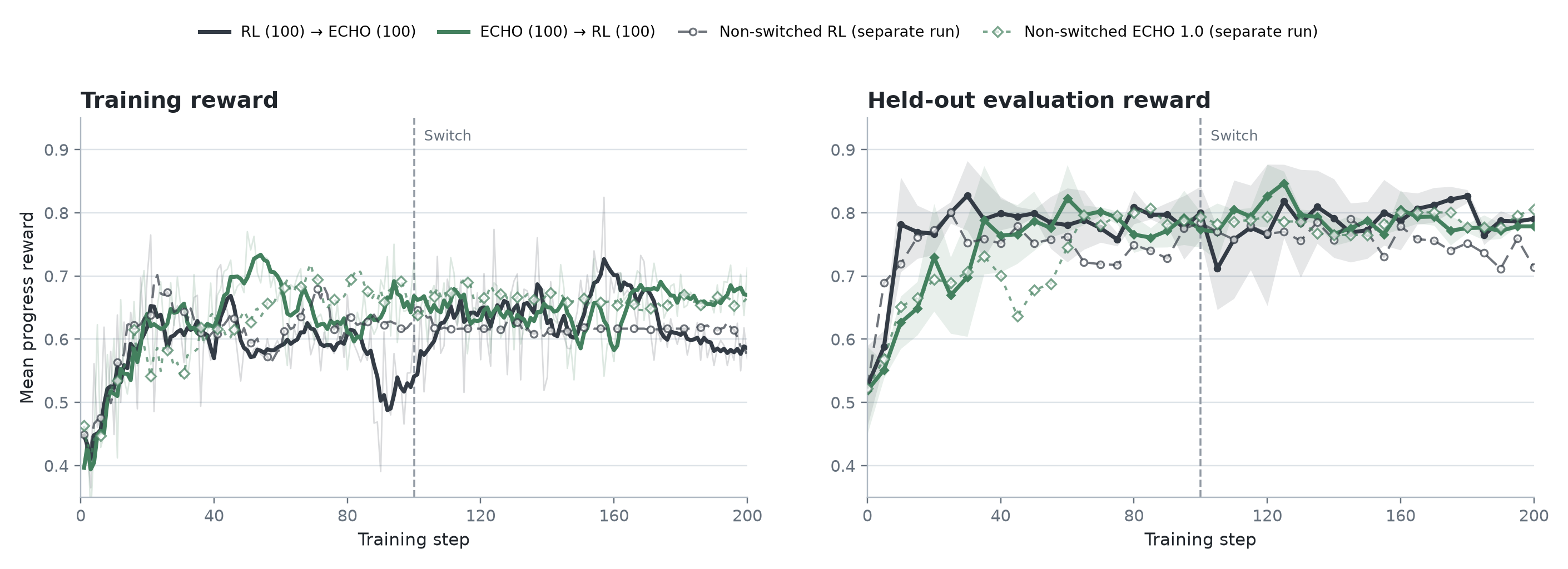
Both schedules remained viable after changing objectives, but their post-switch trajectories differed. RL (100) → ECHO (100) fell from 0.800 at the switch to 0.712 at step 105, then recovered during the ECHO phase and reached a post-switch high of 0.826 at step 180, nearly matching its overall peak of 0.827 at step 30. It finished at 0.790. ECHO (100) → RL (100) reached its overall peak of 0.847 at step 125, shortly after switching to RL, but that gain was not sustained; it finished at 0.779. Both objectives could therefore take over after 100 updates without permanent collapse, but these single runs do not establish a preferred ordering.
Switched after 50 steps
Finally, we tested asymmetric schedules. RL (50) → ECHO (150) asks whether a short RL warmup can establish basic action behavior before a longer ECHO phase jointly improves the policy and observation model. ECHO (50) → RL (150) asks whether a short ECHO warmup can establish useful environment representations before a longer RL phase refines the policy.
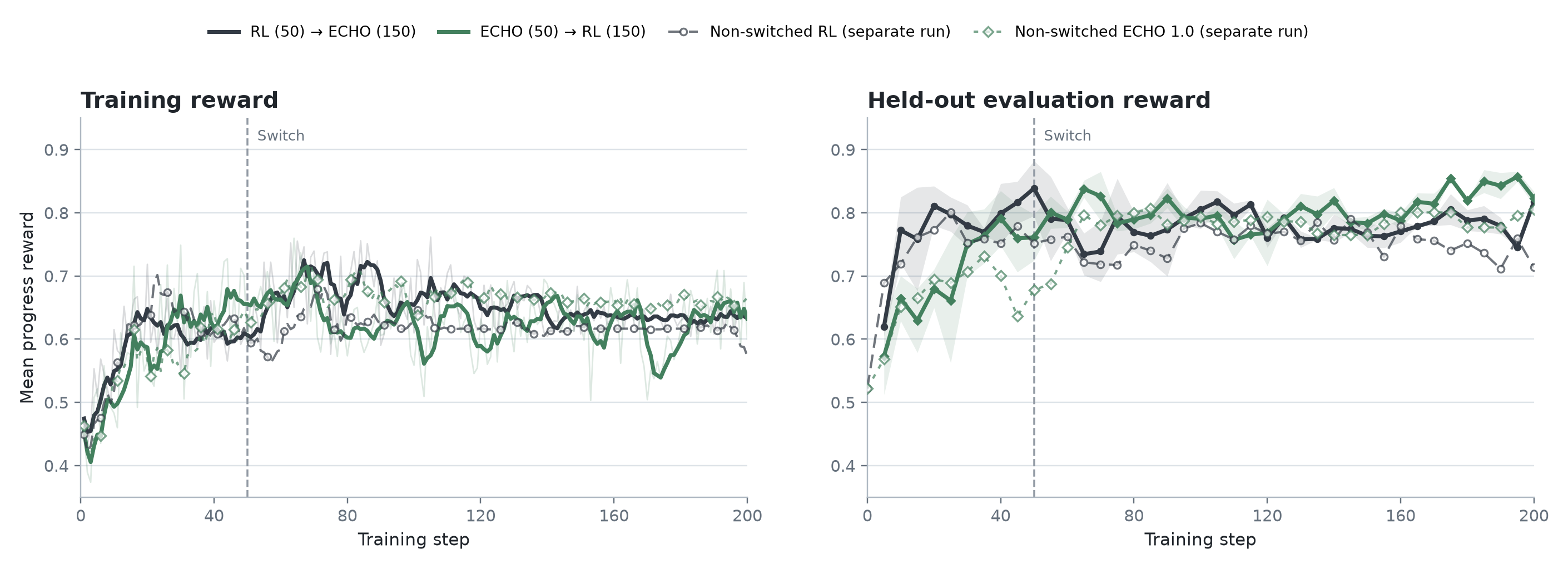
The asymmetric schedules showed different transition behavior. RL (50) → ECHO (150) reached 0.839 at the switch, dropped to 0.735 by step 65, and then recovered during the longer ECHO phase to finish at 0.818, although it never exceeded its step-50 peak. ECHO (50) → RL (150) entered the RL phase at 0.761, improved to 0.838 by step 65, reached 0.857 at step 195, and finished at 0.823. The latter result suggests that a short ECHO warmup followed by standard RL could be a useful schedule: ECHO can first provide dense observation-prediction updates, after which RL can refine the policy directly against reward. ECHO also preserved much of the behavior learned during an RL warmup after an initial dip. Because each schedule was run once, these results motivate replicated warmup experiments rather than establishing a generally superior ordering.
SFT-only ablation
Standard ECHO retains the RL policy objective while adding observation-token prediction. To isolate observation prediction, we tested SFT-only phases in which the RL objective was disabled and training used only supervised next-token prediction over observation tokens. This ablation asks whether observation prediction can maintain or improve task behavior on its own, or whether ECHO’s effect depends on combining it with reward-weighted policy updates. These are single training runs, and each evaluation checkpoint reports the mean and standard deviation across three rollout replicates over 28 held-out tasks.
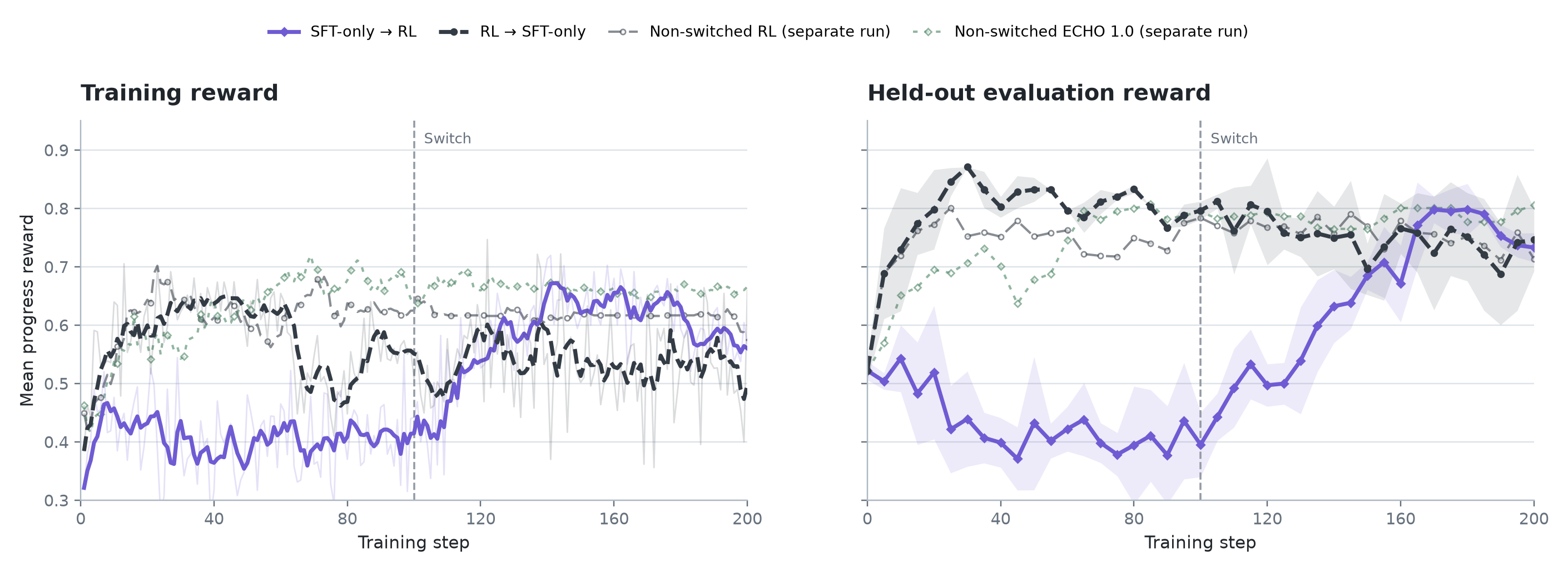
The direction of the effect was clear in both schedules. Under SFT-only training, held-out reward fell during the first 100 steps; switching to RL then recovered it. SFT-only → RL fell from 0.522 at initialization to 0.395 at the switch, then reached a post-switch peak of 0.798 and finished at 0.733. In the reverse direction, RL first raised held-out reward to 0.796 at the switch, while the subsequent SFT-only phase gradually gave back part of that gain and finished at 0.746. In these runs, SFT-only was not an effective warmup or cooldown for RL. The positive results came from standard ECHO, which trains with RL and observation prediction together.
We also tested repeated handoffs by dividing one 200-step run into four equal phases: RL (50) → SFT-only (50) → RL (50) → SFT-only (50). This asks whether the drop in held-out reward observed under SFT-only training repeats after each switch and whether returning to RL can recover task performance more than once.
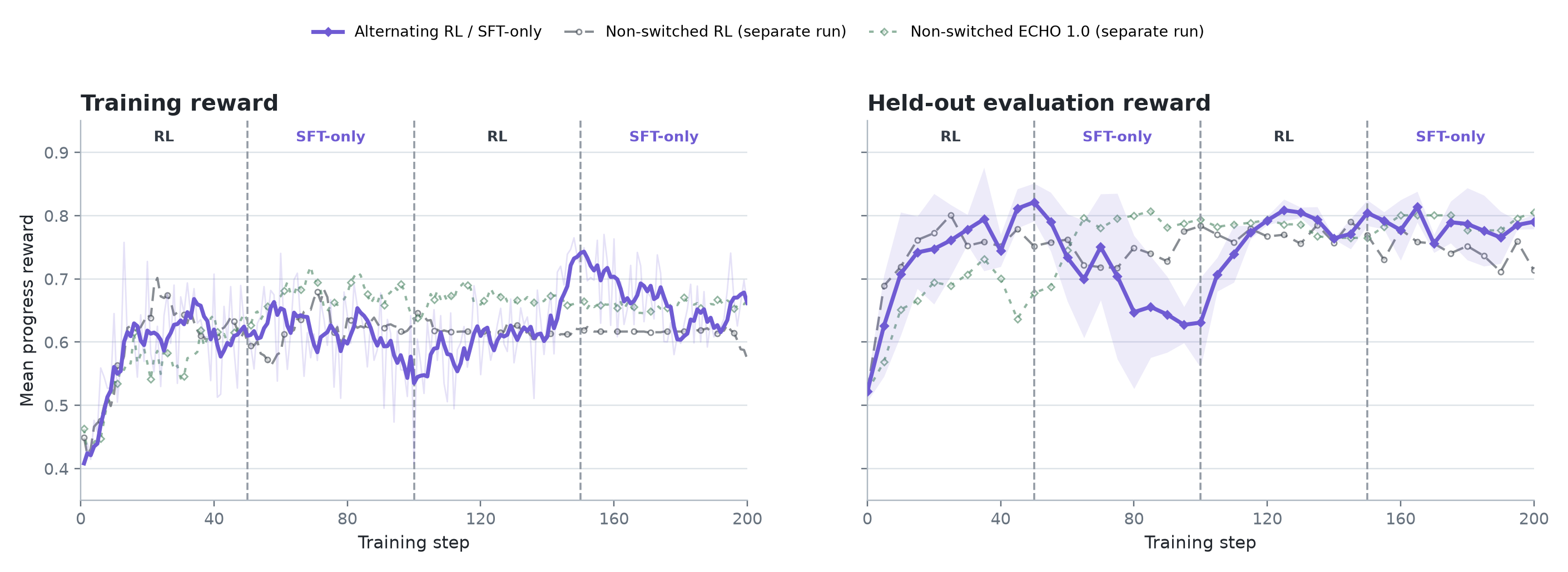
The first RL phase raised held-out reward from 0.522 at initialization to 0.821 at step 50. The first SFT-only phase then reduced it to 0.631 at step 100. Returning to RL recovered the reward to 0.804 at step 150. The final SFT-only phase behaved differently from the first: reward briefly reached 0.814 at step 165 and finished at 0.790, only slightly below its value at the second switch.
RL established and restored task performance, while SFT-only phases generally reduced held-out reward. The first SFT-only phase caused a substantial decline, but the second caused only a small decrease, consistent with the modest degradation in the earlier experiment with 100 RL steps followed by 100 SFT-only steps.
Turn constraint and rollout efficiency
Before each training update, prime-rl filtered rollouts based on zero RL advantage, repetition, and gibberish. Only trajectories that passed these filters were used for training. Both RL and ECHO used the same rollout filters. We observed no obvious repetition or gibberish in the saved trajectories, suggesting that zero advantage was the primary reason for filtering.
Each update required a fixed number of trainable rollouts, so prime-rl continued sampling until the batch was full. The first plot shows the usable-sample rate: the percentage of generated rollouts that passed the filters and were used for training.
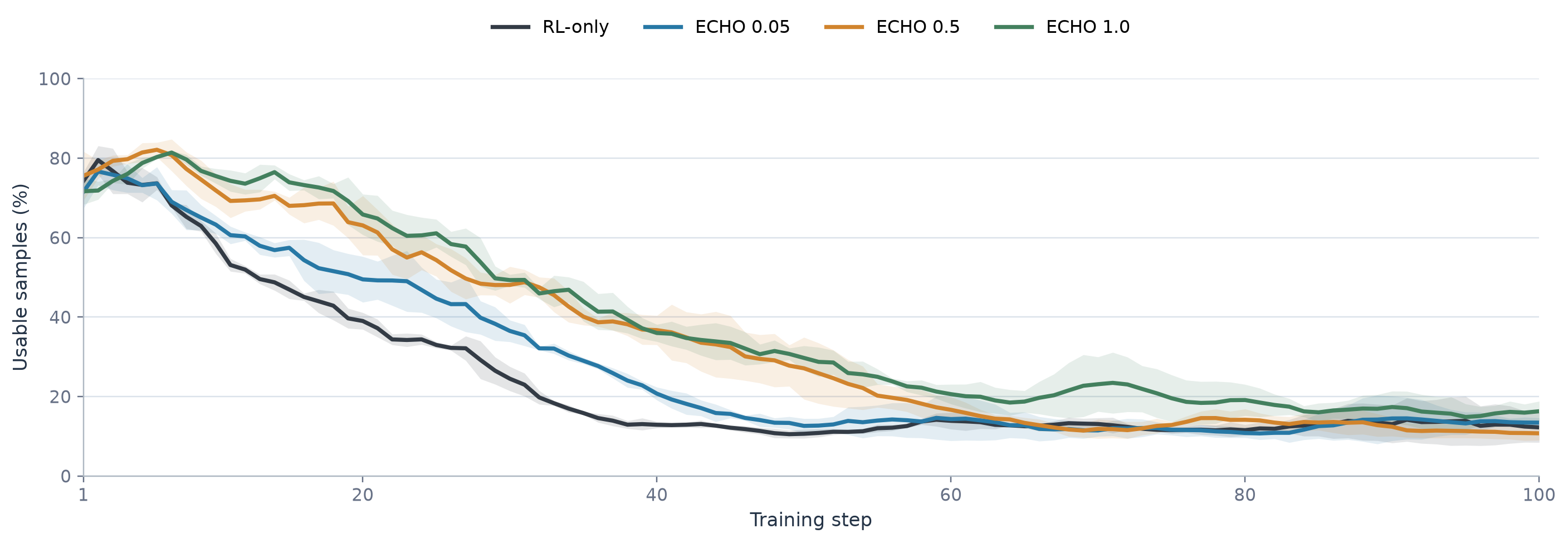
Lines show the five-step moving mean of trainable rollouts divided by generated candidates. Bands are plus or minus one sample standard deviation across three independent runs.
The usable-sample rate increased monotonically with ECHO weight. Across all 100 steps, it rose from 15.4% ± 1.3% for RL to 25.9% ± 2.2% for ECHO 1.0. Correspondingly, the number of extra candidates generated per update fell from 708.9 ± 73.6 to 368.9 ± 43.8. ECHO therefore filled the same-sized training batch with fewer environment interactions.
The next plot shows the average number of turns in trainable rollouts and how often they reached the 20-turn limit.
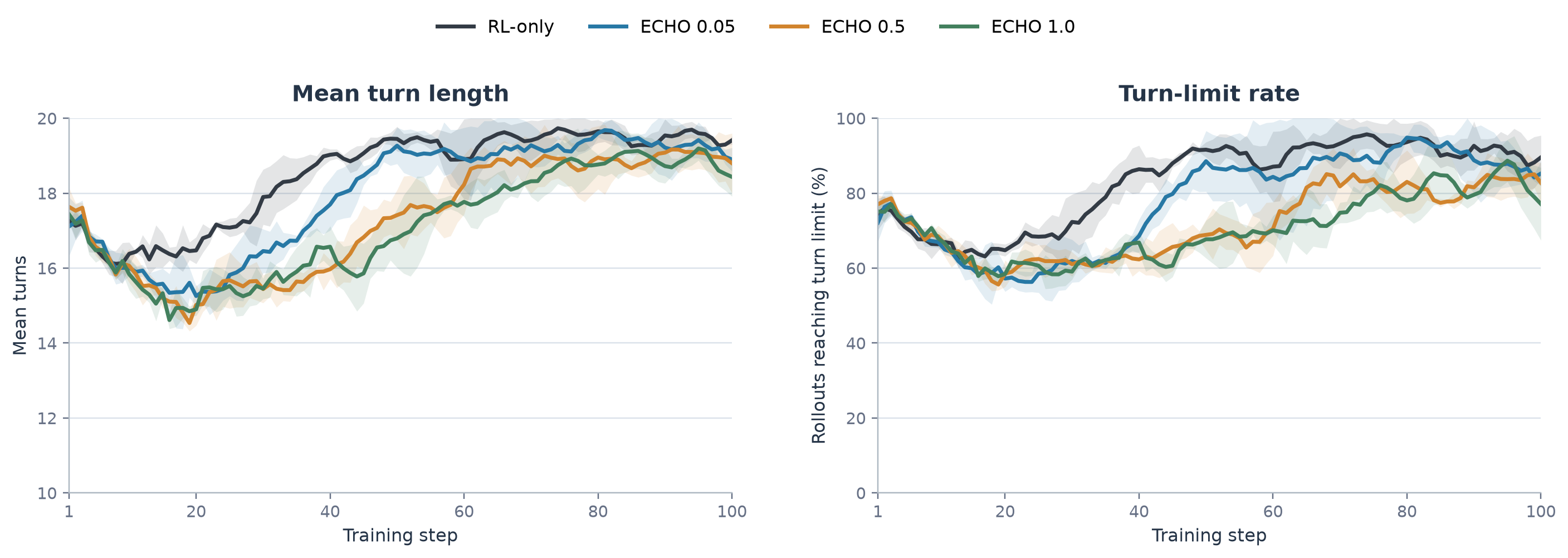
Lines show five-step moving means over trainable rollouts. Bands are plus or minus one sample standard deviation across three independent runs.
RL trajectories averaged 18.56 turns, and 83.4% reached the 20-turn limit. Both measurements fell as ECHO weight increased. At ECHO 1.0, trajectories averaged 17.17 turns and reached the limit 70.7% of the time. All objectives produced longer trajectories later in training, but ECHO delayed the shift toward the turn limit.
The 20-turn cap therefore acts as a coarse length penalty: it assigns no value to progress that would occur after turn 20. Because this limit binds more often for RL, the reward curves measure both task learning and the ability to make progress within a fixed interaction budget. They do not establish how the policies would rank with a larger or unlimited turn budget.
What we learned
These findings come from a constrained BabyAI setting that emphasized fast, reactive decision-making relevant to embodied agents, with a 20-turn interaction limit and explicit thinking disabled. The main 100-step comparison used three independent training runs per objective; the extended schedules and SFT-only ablations each used one run per configuration.
- ECHO improved held-out reward in the main comparison. All three weights finished above RL in mean reward and had lower variation across training runs. ECHO 1.0 produced the strongest final mean.
- ECHO used the constrained interaction budget more efficiently. Higher weights reduced average turn usage and the frequency of reaching the 20-turn limit. These results do not establish whether the advantage would persist with a larger turn budget.
- ECHO needed fewer candidate rollouts to fill a training batch. Higher weights increased the usable-rollout fraction under the same filters. Zero-advantage samples were excluded from both RL and ECHO training.
- ECHO sustained performance better in the 200-step baseline comparison. RL and ECHO 1.0 reached similar peaks, but ECHO finished near its peak while RL declined.
- Some ECHO gains emerged later in training. The ECHO 1.0 baseline peaked later than RL, and several switching schedules improved late. This suggests that longer training horizons could matter more for ECHO.
- The 50/150 schedules were promising. Both directions finished above the RL and ECHO baseline runs.
ECHO (50) → RL (150)continued improving after the switch, motivating further tests of short ECHO warmups followed by RL. - Observation-token SFT alone did not improve task performance here. SFT-only training was feasible, but reward generally declined during those phases and recovered when RL resumed. The positive results came from ECHO’s combined objective of RL and observation prediction.
Reproducibility artifacts
Environment coming soon.
Acknowledgments
This work was completed during the Prime-RL residency. Sebastian Müller (@omouamoua) advised the project, contributed greatly to the design and framing of the study, and helped with the writing. Billy Hoy initiated the project and led the experimentation, writing, and analysis.
Citation
@article{hoy2026echo,
  title   = "ECHO on BabyAI",
  author  = "Hoy, Billy and Müller, Sebastian",
  year    = "2026",
  month   = "October",
  url     = "https://bhoy1.github.io/echo-babyai-findings/"
}